





Replaceable carbide inserts
Contents:
- 1. How to properly choose a cutting tool
- 2. What is a carbide insert?
- 3. Advantages of using carbide inserts
- 4. How to choose a carbide insert
- 5. ISO standard insert marking
- 6. Chipbreaker designation
- 7. Additional parameters
- 8. Q&A
1. How to properly choose a cutting tool.
The correct choice of tool and process planning directly affect productivity and production cost. To select a cutting tool, you need to consider:
- Part characteristics: dimensions, tolerances, drawing, type of machining (longitudinal, facing, profiling), stages (roughing, semi‑finishing, finishing), number of passes.
- Workpiece properties: material, hardness, alloying, surface condition.
- Machine capabilities: type of machine, power, clamping system for workpiece and tool.
Indexable tools with replaceable inserts increasingly replace solid tools thanks to their flexibility and cost‑effectiveness.
2. What is a carbide insert?
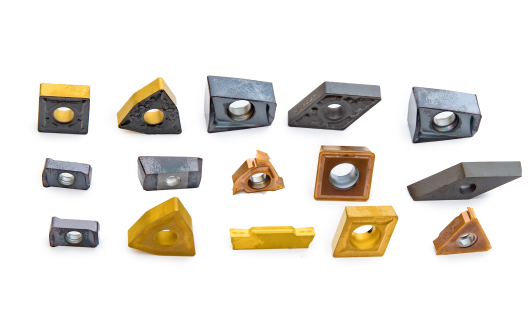
A carbide insert is a replaceable cutting element made of hard alloy based on tungsten carbide, bonded with cobalt and other components. To increase wear resistance, the surface is coated with thin layers of titanium nitride (TiN), titanium aluminum nitride (TiAlN), aluminum titanium nitride (AlTiN) and other coatings (CVD and PVD). This design allows efficient machining of a wide range of materials — from aluminum and copper to hardened steels and heat‑resistant nickel alloys.
3. Advantages of using carbide inserts.
Main advantages of using carbide inserts:
- Cost‑effectiveness: reduced tool costs by replacing only the cutting part.
- Productivity: ability to work at higher cutting speeds compared to high‑speed steel.
- Range and versatility: wide choice of geometries and carbide grades, standardized ISO sizes.
- Ease of maintenance: quick insert replacement without tool re‑setup.
- Durability: use of modern coatings that increase tool life.
4. How to choose a carbide insert?
Main selection criteria:
- Workpiece material (P – steel, M – stainless steel, K – cast iron, N – non‑ferrous metals, S – heat‑resistant alloys, H – hardened steels).
- Carbide grade and coating (determine wear resistance and thermal conductivity).
- Geometry and nose radius (affect surface quality and tool life).
- Chipbreaker type (optimizes chip formation and removal).
Also consider: type of machining (turning, milling, drilling, threading) and clamping method (screw, clamp, combined).
4.1 Groups of machinable materials
Materials are divided into six categories:
- P (Steel): Carbon steel — steel without specially added alloying elements, properties mainly defined by carbon content.
- Alloy steel (low‑ and medium‑alloyed) — alloying elements are added to improve properties: strength, hardenability, wear resistance, heat resistance.
- High‑alloy steel — very high alloy content, giving special properties: corrosion resistance, heat resistance, or high‑temperature strength.
- M (Stainless steel): Alloyed steel with more than 11% chromium (Cr).
- K (Cast iron): iron‑carbon alloy, carbon content usually from 2.14%.
- N (Non‑ferrous metals): not containing iron; soft metals (hardness less than 130 HB). Includes aluminum, copper, brass, etc.
- S (Heat‑resistant alloys): many high‑alloy materials based on iron, nickel, cobalt, and titanium.
- H (High‑hardness materials): materials of high hardness. Includes steels with hardness 45‑65 HRc and chilled cast iron with hardness 400‑600 HB.
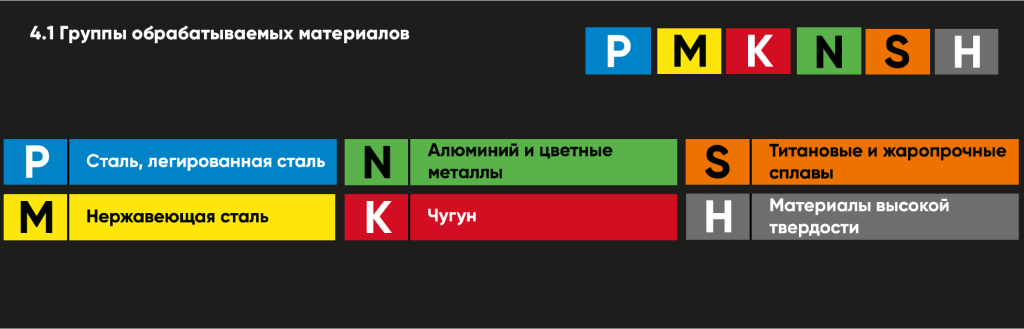
Fig.4.1
4.2 Types of inserts by operation
Different operations such as turning or milling require special inserts. Carbide inserts by operation are mainly divided into:
- for turning;
- for milling;
- for drilling;
- for threading.
4.3 Classification of turning toolholders by insert clamping type
Carbide inserts are clamped in different ways, designated by letters.
- C – Top clamp
- P – Pin
- M – Top clamp and pin
- D – Clamp holding from top and through hole
- S – Screw
5. ISO standard insert marking
ISO marking contains information about:
insert shape (rhombic, square, trigonal, triangular);
angles (rake/relief);
accuracy class;
clamping method;
cutting edge length;
chipbreaker type.
Correct reading of the marking allows quick selection of an insert for a specific tool and operation.

Fig.5. Carbide insert marking.
Fig.5.1. Insert shape.
5.2. Relief angle.
The relief angle of the insert is the angle between the relief surface and the cutting plane. The size of the relief angle affects cutting forces during machining. For internal machining and flexible parts, inserts with relief angles are recommended, as they reduce cutting forces.
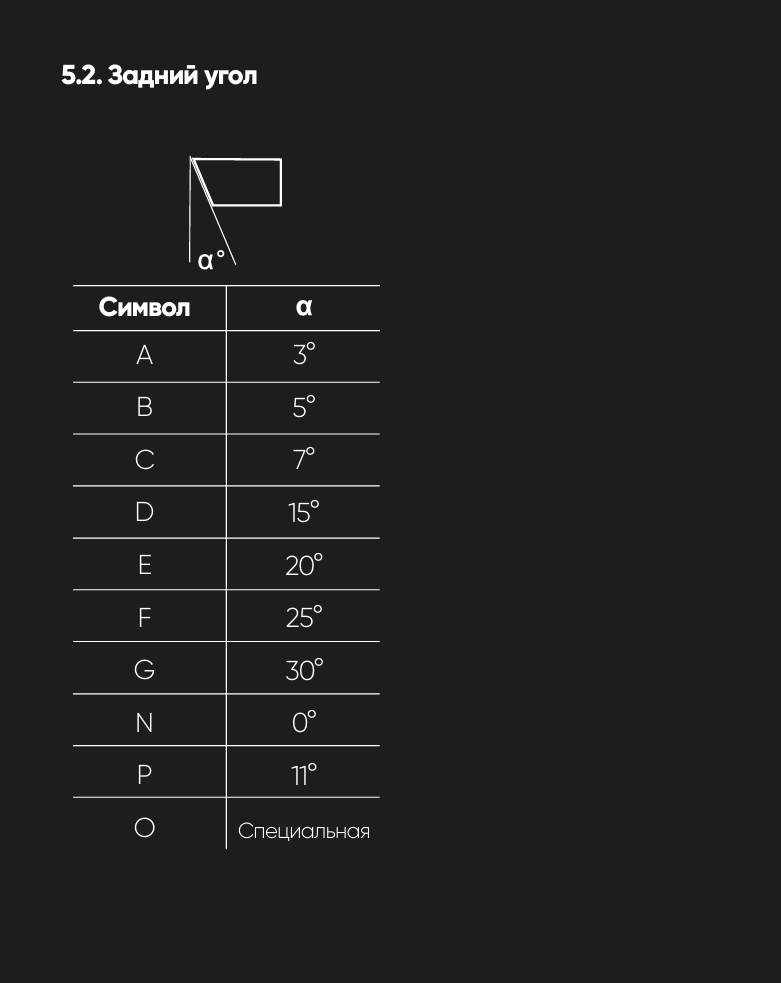
Fig.5.2. Relief angle of the insert.
5.3. Rake angle.
The rake angle of the insert is the angle between the rake surface and the main plane. Depending on the rake angle, inserts can be negative (angle between rake and relief surfaces 90°) or positive (angle less than 90°). Negative inserts are double‑sided, stronger, and intended for roughing. Positive inserts are single‑sided, sharper, and intended for finishing and machining tough materials.
5.4. Accuracy class.
Defines permissible dimensional deviations of the insert.
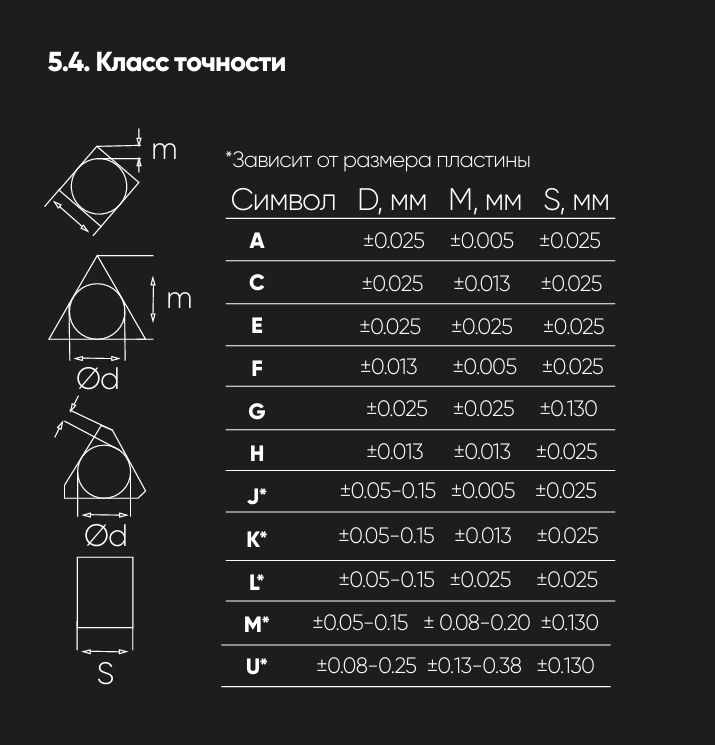
Fig.5.4. Accuracy class.
5.5. Clamping type and chipbreaker.
Indicates the method of fixation and chip removal during machining.
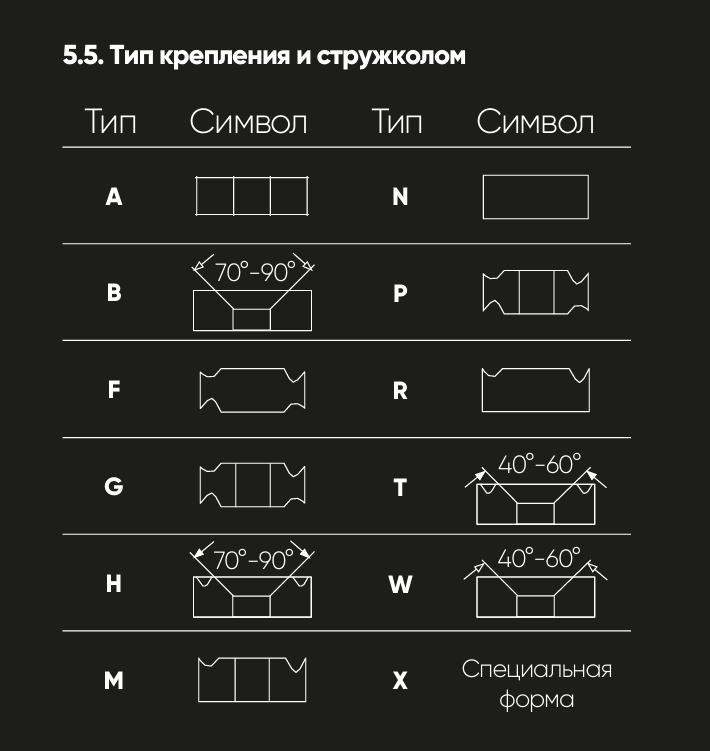
Fig.5.5. Clamping type and chipbreaker.
5.6. Cutting edge length.
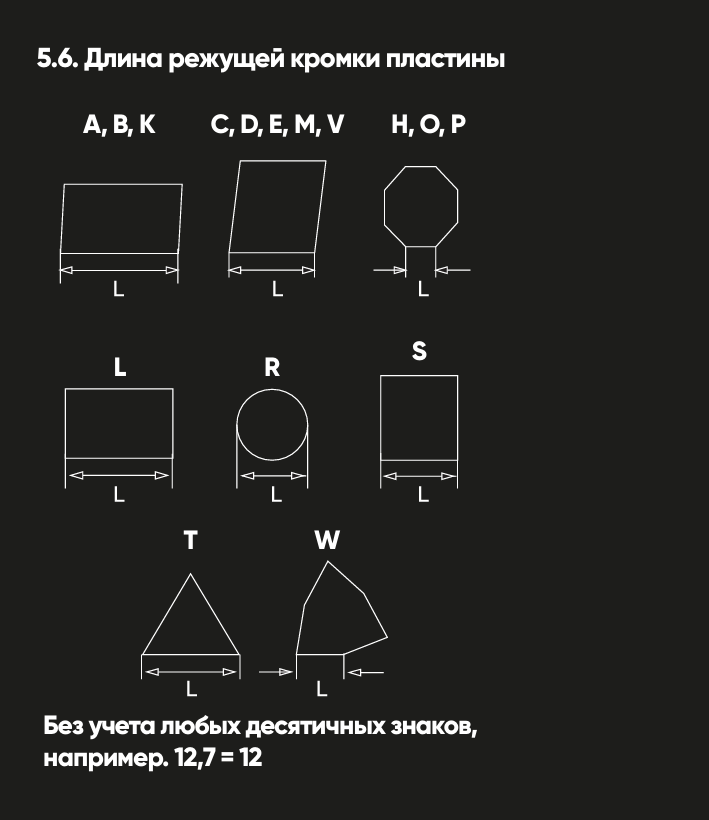
Fig.5.6. Cutting edge length.
5.7. Insert thickness.
Insert thickness is an important parameter that affects its strength and resistance to loads during machining. The greater the thickness, the higher its ability to withstand mechanical stress, which is especially important in roughing.
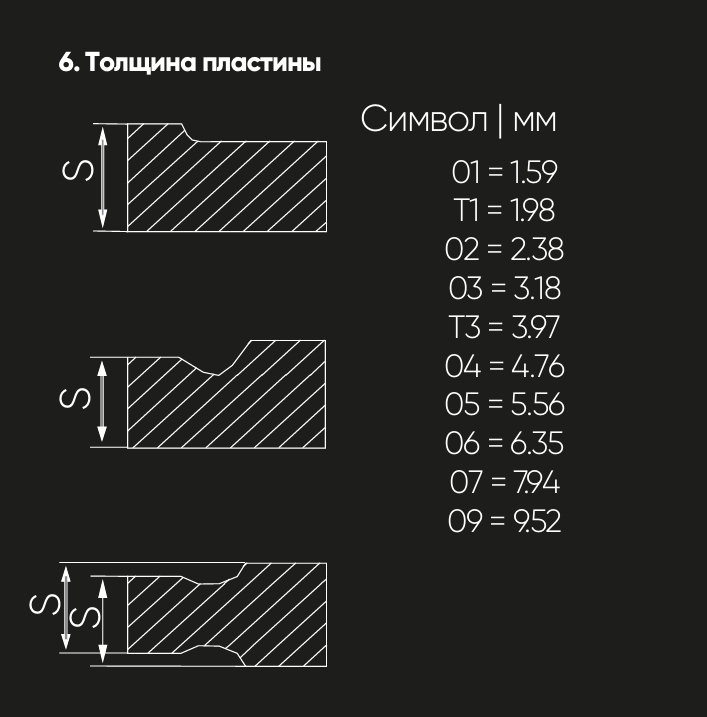
Fig.6. Insert thickness.
5.8. Nose radius.
The nose radius of the insert determines surface quality after machining and cutting forces. A smaller radius is suitable for finishing, providing a smooth surface, while a larger radius is used for roughing, increasing tool life.
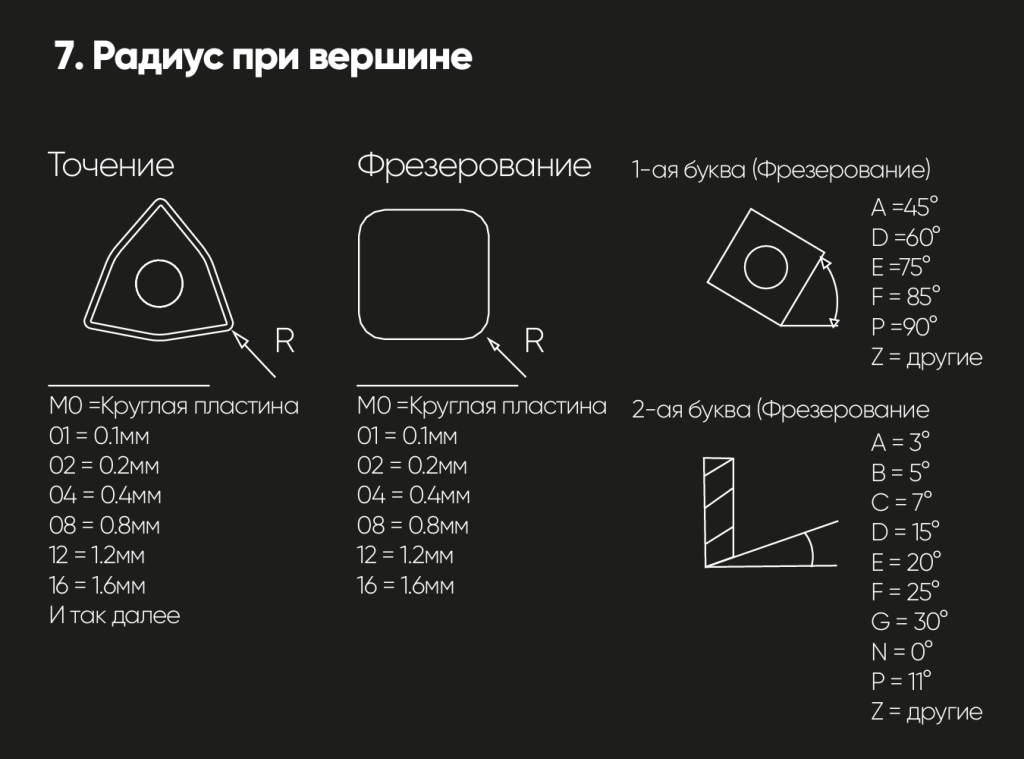
Fig.7. Nose radius.
5.9. Cutting edge type.
Cutting edge type affects the cutting process:
Sharp edge provides high accuracy and quality at low cutting forces.
Reinforced edge is used for machining hard materials where high tool life is required.
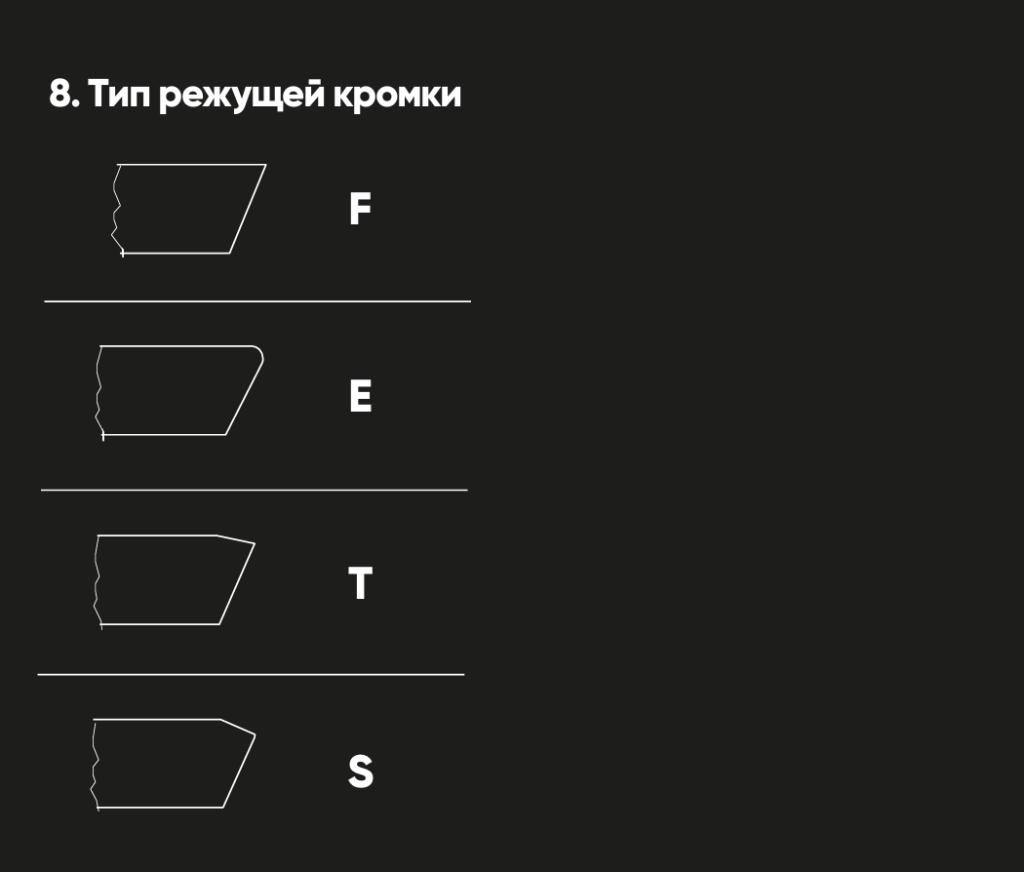
Fig.8. Cutting edge type.
5.10. Cutting direction
Turning inserts are mainly produced neutral, allowing machining on toolholders for both left‑hand and right‑hand cutting, but there are also inserts with left and right chipbreakers for specific tasks.
Milling inserts are mainly produced for right‑hand milling (clockwise rotation), but neutral and left‑hand milling inserts also exist.

Fig.9. Cutting direction with insert.
6. Chipbreaker designation
A chipbreaker is an element of insert geometry that controls chip formation and removal during machining.
For example:
PF — finishing steel;
PM — semi‑finishing.
Each manufacturer has its own designations, so it is important to use supplier catalogs for accurate selection.
7. Additional parameters
Manufacturers may add symbols to indicate application conditions:
- Roughing — high cutting speed and heavy loads.
- Semi‑finishing — universal range of parameters.
- Finishing — low cutting forces at small depths of cut.
8. Q&A
What is the cost of carbide inserts?
The price of a carbide insert depends on the manufacturer (brand), geometry, parameters, and grade. Our company covers the full price range from budget to premium.
Where can I find insert marking?
Marking is located on the packaging, where the manufacturer also provides recommended cutting conditions and chipbreaker information. Some manufacturers mark the grade directly on the insert edge.
How to select cutting conditions?
Cutting parameters affect tool life. Recommended (average) cutting conditions are indicated on the insert packaging and in the manufacturer’s catalog. Calculation of cutting conditions for your specific machining operation is based on your production data: part drawing, workpiece dimensions, insert geometry, material parameters, and machine. For calculation, you can contact our company, and specialists will help select optimal conditions and develop a technological solution for your task.
Important information!
The information presented in technical articles and reviews on the Site is for informational and educational purposes only and is intended for general understanding of the principles of operation, characteristics, and application of cutting tools and machine tooling.
All calculations, formulas, recommendations, and technical data provided in the materials are taken from manufacturer catalogs and may be used only as reference values. Final determination of parameters and application conditions must be made by a qualified specialist (technologist, engineer) in production or by a qualified employee of our company.
Iron Park LLC is not responsible for possible errors, omissions, or misuse of the information contained in the articles and reviews.
We recommend always consulting a technical specialist before applying recommendations in production conditions.