





Calculation of cutting conditions during milling

Contents:
1. Milling: features of mechanical cutting
Milling is a machining process in which the cutting tool (milling cutter) performs a rotary motion, while the workpiece moves linearly. This method is widely used for machining various surfaces and materials.
1.1 Types of milling
Depending on the type of cutter used and the nature of the machined surface, the main types of milling are divided into the following categories:
- Face milling — machining flat surfaces with face mills;
- Slot and shoulder milling — machining grooves, slots, and stepped surfaces;
- Profile (contour, volumetric) milling — machining complex contours and curved surfaces.
1.2 Main cutting modes
When performing milling operations, the key cutting parameters are:
- Feed per tooth — the distance the workpiece travels per one tooth revolution;
- Cutting speed — the speed of the cutting edge relative to the material being machined;
- Thickness of removed layer (allowance) — the volume of material removed per pass.
1.3 Adjustable process parameters
During milling, the following parameters can be adjusted:
- Depth of cut: thickness of the material layer removed per pass. Depth of cut directly affects productivity and tool load;
- Width of cut: the width of the removed layer of metal in the direction perpendicular to feed motion. This parameter is important for evaluating cutting forces;
- Tool feed: movement of the workpiece relative to the cutter’s axis of rotation.
Feed can be calculated in the following units:
- per tooth;
- per revolution;
- per minute.
1.4 Factors affecting feed rate
Several factors influence the choice of feed rate:
- Tool strength — the ability of the cutting edge to withstand loads without damage;
- Rigidity of the technological system — stability of the machine design and workpiece clamping;
- Machine power — the ability of the machine to maintain set machining parameters without overload.
Milling remains one of the most in-demand machining methods due to its versatility and high accuracy. Proper adjustment of cutting modes and process parameters allows achieving optimal results with minimal time and tool resource costs.
2. Formulas for calculating cutting modes in milling
2.1 Spindle speed, (rpm)
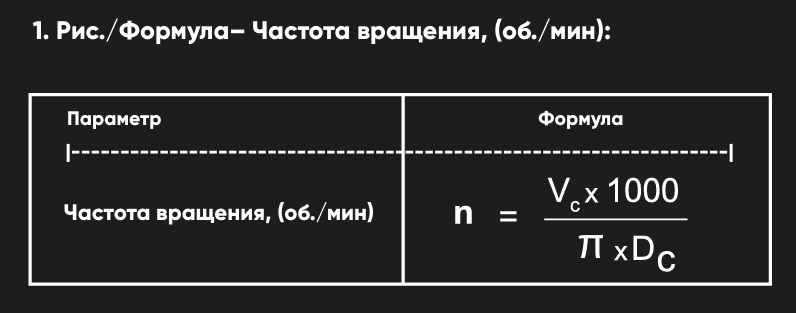
Fig./Formula – Spindle speed, (rpm)
Spindle speed, (rpm)
where,
Vc – Cutting speed, m/min;
π – constant equal to 3.14;
Dc – cutter diameter, mm.
2.2 Cutting speed, (m/min)
Cutting speed is one of the main parameters affecting insert wear. It most strongly influences flank wear (the most common type of wear).
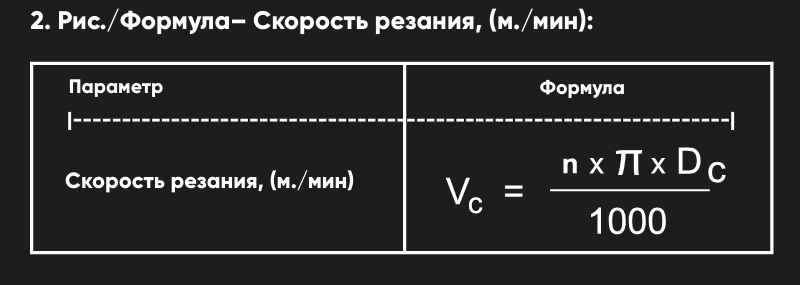
Fig./Formula – Cutting speed, (m/min)
Cutting speed, (m/min)
where,
Vc – Cutting speed, m/min;
π – constant equal to 3.14;
Dc – cutter diameter, mm.
2.3 Feed per minute, (mm/min)
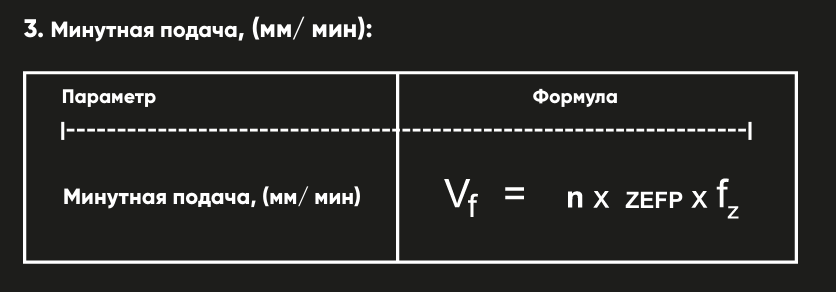
Fig./Formula – Feed, (mm/min)
where,
Vf – feed per minute, mm/min;
fz – feed per tooth, mm/tooth;
n – spindle speed, rpm;
ZEFP – effective number of teeth for feed calculation, pcs.
2.4 Feed per tooth, (mm/tooth)
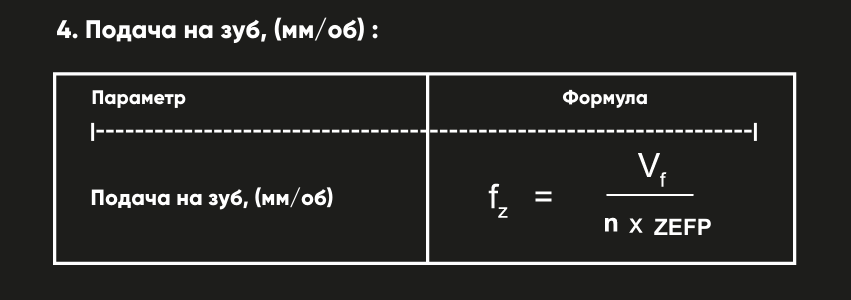
Fig./Formula – Feed per tooth, (mm/tooth)
where,
fz – feed per tooth, mm/tooth;
Vf – feed per minute, mm/min;
n – spindle speed, rpm;
ZEFP – effective number of teeth for feed calculation, pcs.
Effective number of teeth (ZEFP) is used to calculate feed rate (Vf) and feed per revolution (f). For most cutters, ZEFP equals the number of cutter teeth (ZNP), but for some cutters ZEFP is less than ZNP.
2.5 Feed per revolution, (mm/rev)
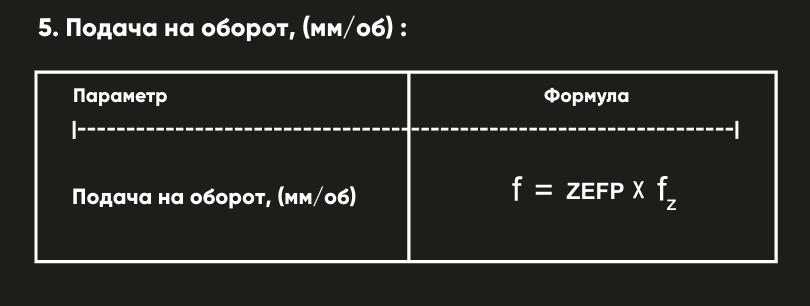
Fig./Formula – Feed per revolution, (mm/rev)
Feed per revolution, (mm/rev)
where,
f = feed per revolution;
ZEFP – effective number of teeth for feed calculation, pcs;
fz = feed per tooth.
2.6 Material removal rate, (cm³/min)
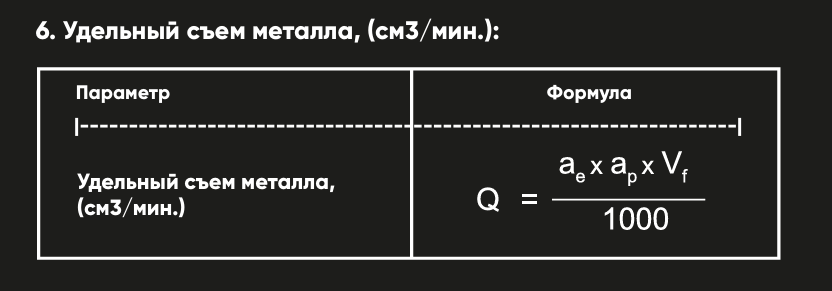
Fig./Formula – Material removal rate, (cm³/min)
Material removal rate, (cm³/min)
where,
ae – width of cut mm / radial depth of cut, mm;
ap – depth of cut mm / axial depth of cut, mm;
Vf – feed, mm/min.
2.7 Cutting speed and spindle speed for volumetric milling
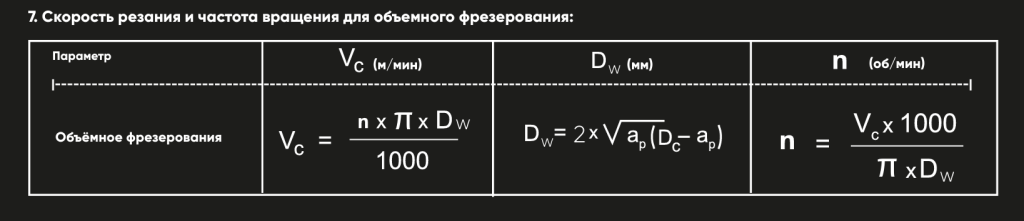
Fig./Formula – Cutting speed and spindle speed for volumetric milling
Cutting speed and spindle speed for volumetric milling
where,
Vc – cutting speed, m/min;
π – constant equal to 3.14;
Dc – cutter diameter, mm;
ap – depth of cut mm / axial depth of cut, mm.
2.8 Recommendations for choosing cutting modes
8.1 Influence of workpiece material (average values)
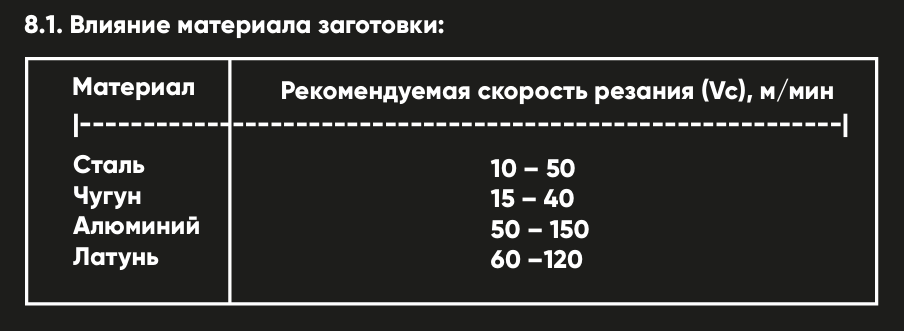
Note: for carbide cutters, Vc values may be higher.

8.2 Influence of tool material
2.9 General recommendations for use
- When choosing cutting modes, consider the machine power and rigidity of the "machine — tool — workpiece" system.
- Start with recommended values from handbooks and tool manufacturer catalogs, then adjust them depending on specific machining conditions.
- When machining hard or hardened materials, use carbide tools and tools with cubic boron nitride (CBN); ceramic tools may also be used.
- When machining difficult‑to‑cut materials, heat‑resistant alloys — ceramic tools are recommended.
- Monitor tool wear — if it worsens, reduce cutting speed or increase regrinding intervals.
Conclusion
Before choosing optimal cutting modes, it is necessary to determine the criterion for their adjustment. This may be maximum productivity, minimization of tool costs, or a balance between these two parameters.
Maximum productivity implies using high cutting modes, which leads to increased tool costs due to accelerated wear. However, increased productivity also reduces labor costs and equipment depreciation, making this approach profitable under certain conditions.
On the other hand, economic efficiency requires accounting for all costs, including tool expenses, labor costs, and equipment depreciation. In each case, it is important to individually determine the optimization goal, considering the specifics of the cutting equipment, part type, and labor payment system at the enterprise.
Thus, the task of choosing cutting modes should be based on a comprehensive analysis of production conditions and economic factors.
Important information!
The information presented in technical articles and reviews on the Site is for informational and educational purposes only and is intended for general understanding of the principles of operation, characteristics, and application of cutting tools and machine tooling.
All calculations, formulas, recommendations, and technical data provided in the materials are taken from manufacturer catalogs and may be used only as reference values. Final determination of parameters and application conditions must be made by a qualified specialist (technologist, engineer) in production or by a qualified employee of our company.
Iron Park LLC is not responsible for possible errors, omissions, or misuse of the information contained in the articles and reviews.
We recommend always consulting a technical specialist before applying recommendations in production conditions.