





Calculation of cutting modes during turning

Contents:
- 1.1 Cutting speed, (m/min)
- 1.2 Spindle speed, (rpm)
- 1.3 Depth of cut, (mm)
- 1.4 Surface roughness, (µm)
- 1.5 Power consumption evaluation, (kW)
- 1.6 Material removal rate, (cm³/min)
Optimal cutting mode: concept and selection methodology
A rational cutting mode is such a machining mode in which a part of the required quality is produced with minimal costs, including tool expenses. This approach is based on achieving an economically feasible tool life period.
Factors influencing the choice of cutting mode
When choosing a cutting mode, the following parameters must be considered:
- workpiece material: its grade and physical-mechanical properties;
- surface condition of the workpiece: presence of defects, roughness, and other characteristics;
- type of machining: roughing, semi-roughing/semi-finishing, finishing;
- type of turning: longitudinal, facing, or profiling;
- machining conditions: continuous or interrupted process.
These factors determine the optimal cutting parameters that ensure a balance between productivity and economic efficiency.
Methodology for assigning a rational cutting mode
- Selection of tool material. Choosing the alloy for the cutting part of the tool or carbide insert depending on the workpiece material.
- Determination of depth of cut. Setting the thickness of the material layer removed per pass.
- Assignment of feed. Calculating tool feed (per tooth, per revolution, or per minute) considering tool strength, system rigidity, and machine power.
- Determination of cutting speed. Choosing the optimal speed of the cutting edge relative to the workpiece to achieve maximum productivity with minimal tool wear.
Rational choice of cutting mode ensures high machining quality and minimizes tool and equipment operating costs.
1.1 Cutting speed, (m/min)
Cutting speed is the distance traveled by a point on the cutting edge relative to the workpiece surface per unit of time. In turning, this is a rotary motion. Measured in m/min.
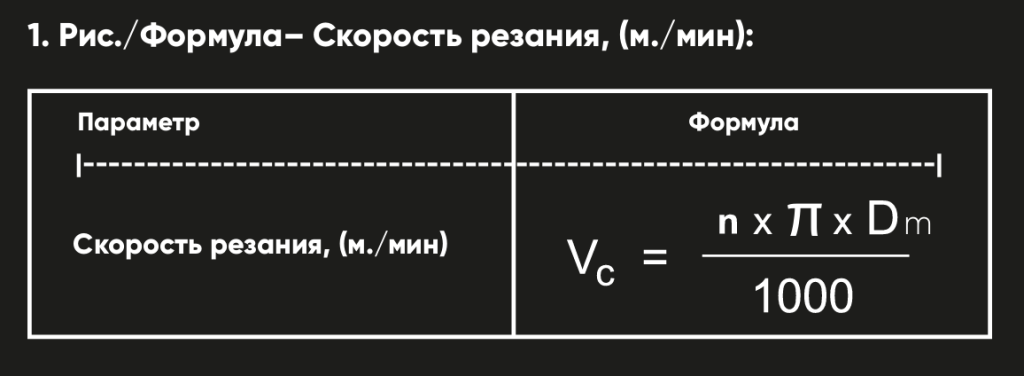
Fig./Formula – Cutting speed (m/min)
where,
π – constant equal to 3.14;
Dm – workpiece diameter, mm;
n – spindle speed, rpm.
1.2 Spindle speed, (rpm)
Spindle speed is the number of revolutions the spindle makes per unit of time. Measured in rpm and plays an important role in machine setup.
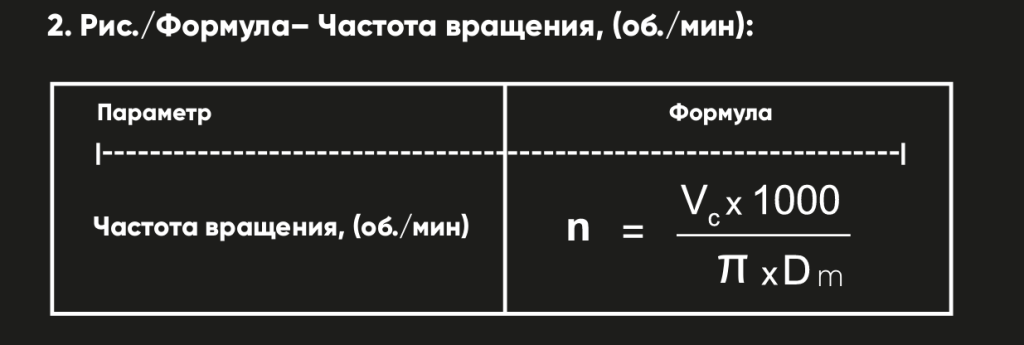
Fig./Formula – Spindle speed, (rpm)
where,
Vc – cutting speed, m/min;
π – constant equal to 3.14;
Dm – workpiece diameter, mm.
1.3 Depth of cut, (mm)
Depth of cut is the distance between the unmachined and machined surfaces of the workpiece, measured perpendicular to the feed direction.
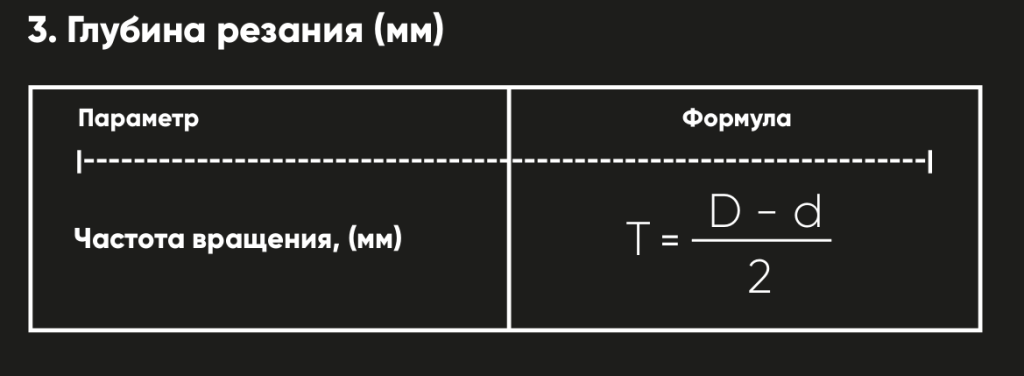
Fig./Formula – Depth of cut
where,
t – depth of cut;
D – diameter before tool pass;
d – diameter after tool pass.
1.4 Surface roughness, (µm)
Surface roughness characterizes the micro-irregularities of the material surface. The lower the value, the smoother the surface.
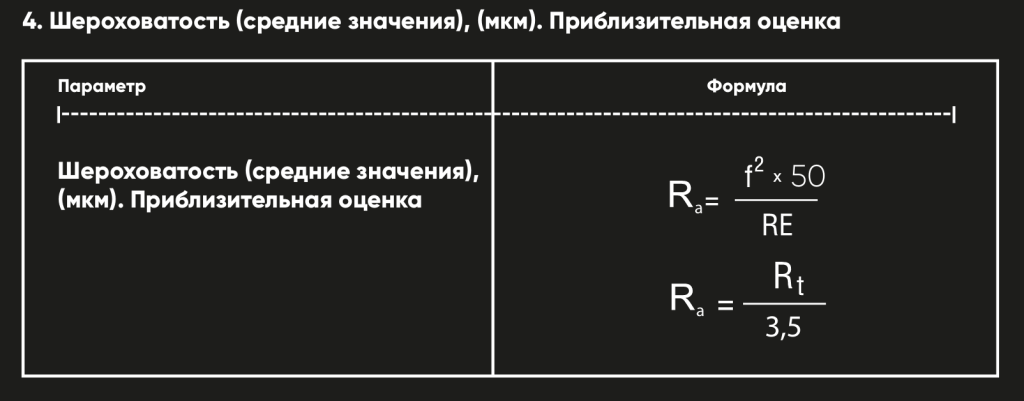
Fig./Formula – Roughness (average values)
where,
Ra – roughness, µm;
Re – nose radius, mm;
Rt – total profile height, µm.
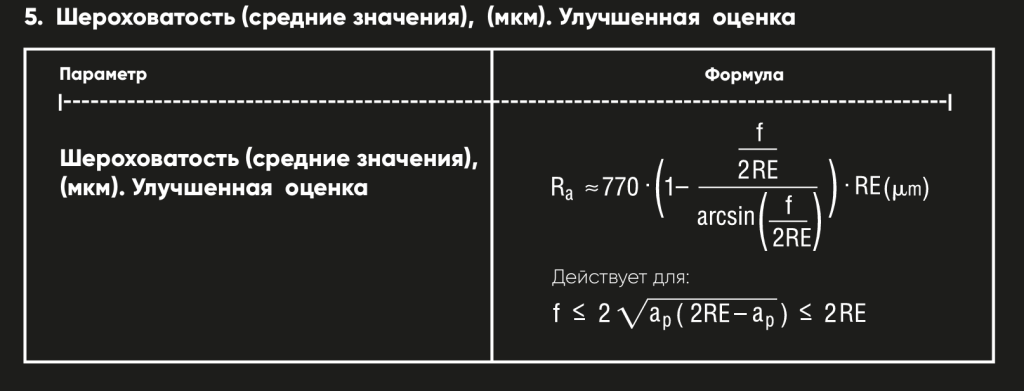
Fig. Improved values
- Approximate values:
- Very smooth surface: <0.1 µm (Ra)
- Well-machined surface: 0.1–0.4 µm (Ra)
- Medium surface: 0.4–1.6 µm (Ra)
- Rough surface: 1.6–6.3 µm (Ra)
- Very rough surface: >6.3 µm (Ra)
1.5 Power consumption evaluation, (kW)
Power consumption evaluation is the determination of the amount of energy used by the process over a certain period of time.
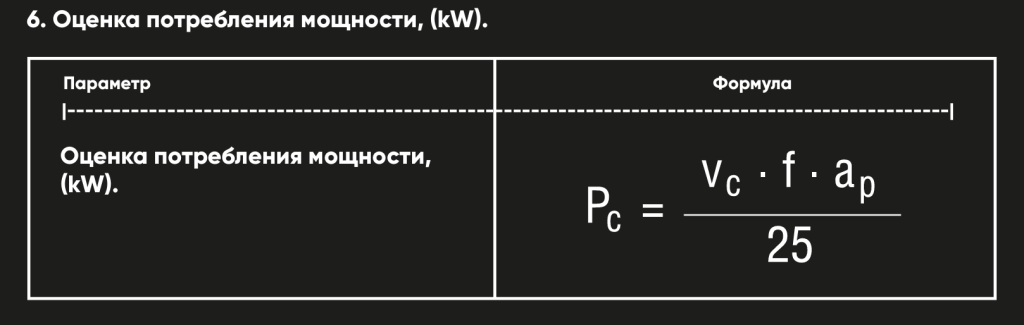
Fig./Formula – Power consumption evaluation, (kW)
where,
Pc – required power, kW;
Vc – cutting speed, m/min;
f – feed, mm/rev;
ap – depth of cut, mm.
1.6 Material removal rate, (cm³/min)
Material removal rate is the amount of material removed during machining. An important efficiency criterion.
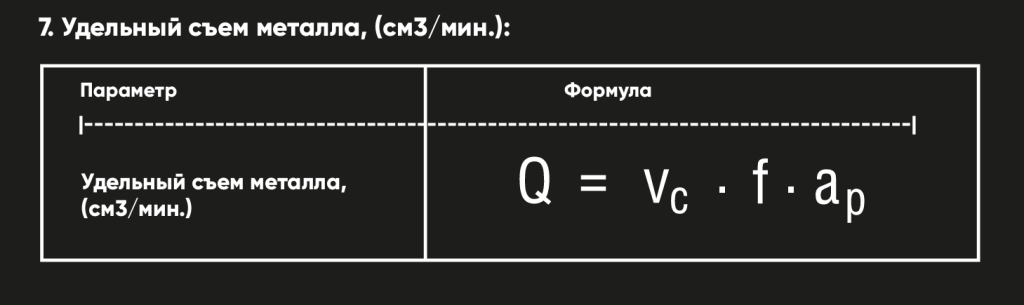
Fig./Formula – Material removal rate (cm³/min)
where,
Vc – cutting speed, m/min;
f – feed, mm/rev;
ap – depth of cut, mm.
Conclusion
A rational cutting mode is a compromise between machining quality, productivity, and costs. An individual approach increases production efficiency, reduces expenses, and ensures process sustainability.
Important information!
The information presented in technical articles and reviews on the Site is for informational and educational purposes only and is intended for general understanding of the principles of operation, characteristics, and application of cutting tools and machine tooling.
All calculations, formulas, recommendations, and technical data provided in the materials are taken from manufacturer catalogs and may be used only as reference values.